California prisons face conditions so extreme that the U.S. Supreme Court has stepped in, ordering the state to take immediate steps to significantly reduce our prison population to comply with Constitutional standards.
The Problem: Over‐incarceration and High Recidivism
Today, the United States has 5% of the world’s population and 25% of the world’s incarcerated population. The state of California houses one of the largest prison and jail populations within the U.S. Despite extremely high state and local incarceration rates, California’s recidivism rate of 67.5% is among the highest in the nation. California prisons face conditions so extreme that the U.S. Supreme Court has stepped in, ordering the state to take immediate steps to significantly reduce our prison population to comply with Constitutional standards.
The Solution: County‐level, Evidence‐based Alternatives to Incarceration
Your county can be part of the solution. With the passage of AB 109 and subsequent amending legislation (“The 2011 Realignment Legislation Addressing Public Safety”), your county government assumes significant new corrections, reentry and community supervision responsibilities for people convicted of certain non-serious, non-violent felonies. Broadly speaking, realignment refers to changes in the assignment of program and fiscal responsibilities between the state and local governments. In the context of AB 109, realignment refers to the shifting of criminal justice responsibilities from the state prisons and parole board to local county officials and superior courts.
AB 109 realignment goes into effect on October 1, 2011. The state is providing funding to counties to offset some of the local costs realignment will bring. Each county is required to develop a realignment implementation plan, to be voted on by a seven-member committee of county officials and submitted to its Board of Supervisors. This Report will provide local government officials, service providers and the public with the information and tools needed to collaboratively develop successful realignment implementation plans.
Date
Monday, August 1, 2011 - 12:00am
Featured image
Show featured image
Hide banner image
Documents
Show related content
Tweet Text
[node:title]
Type
Menu parent dynamic listing
Style
Standard with sidebar
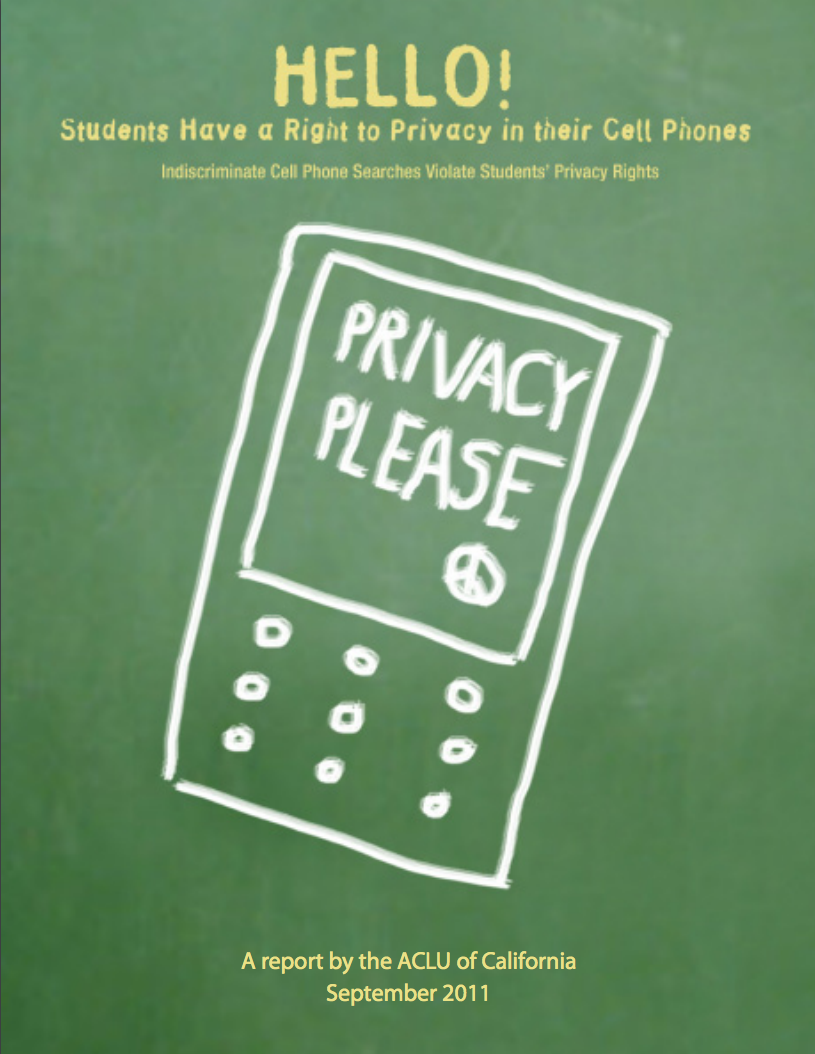
Indiscriminate cell phone searches threaten students' privacy rights in ways that have never before been possible. Sweeping searches threaten to expose a tremendous amount of private, personal information, and to teach our youth that such invasions of privacy are routine parts of civic life.
The right to privacy is one of our most basic and cherished constitutional rights. It protects us from unwarranted government intrusions into our personal affairs. As one of our most well known and highly respected U.S. Supreme Court justices put it nearly eighty years ago, the drafters of the Constitution “sought to protect Americans in their beliefs, their thoughts, their emotions and their sensations. They conferred, as against the government, the right to be let alone – the most comprehensive of rights and the right most valued by civilized men. To protect that right, every unjustifiable intrusion by the government upon the privacy of the individual, whatever the means employed, must be deemed a violation of the [Constitution]. ”
The American Civil Liberties Union (ACLU) has a long and proud history of defending the right to privacy. As technology has advanced, the law has often struggled to keep pace and ensure protection for personal information. As technology now provides new ways to gather information and databases containing personal information proliferate, the need for privacy protections becomes more urgent. The ACLU is a national leader in working to guarantee that individuals may determine how and when the government can gain access to their personal information.
The ACLU has protected employees in their personal electronic mail; patients in their medical records and, indeed, their very DNA; airline passengers in the face of intrusive and ineffective full body scans; internet users in their profiles, search histories and purchases; and cell phone users in their phone records and data. The ACLU also has long advocated to protect the privacy rights of public school students. Although it has long been established that students do not shed their constitutional rights at the schoolhouse gate, 2 students’ privacy rights have been under constant threat of erosion. The ACLU has been at the forefront of their defense, opposing such invasions of student privacy as electronic monitoring and tagging of jerseys and backpacks, the collection of student information in electronic databases to be shared with the federal government and military recruiters, random drug testing, and unreasonable surveillance.
This report addresses the intersection of technology and student rights – the searches and seizures of students’ cell phones.
Date
Thursday, September 1, 2011 - 12:00am
Featured image
Show featured image
Hide banner image
Related issues
Privacy and Surveillance
Education Equity
Documents
Show related content
Tweet Text
[node:title]
Type
Menu parent dynamic listing
Style
Standard with sidebar
Los Angeles’ daytime curfew pushes students away from school and diverts resources away from real community safety.
In 1995, the Los Angeles City Council passed an ordinance establishing a daytime curfew for the city’s youth. Promulgated as Los Angeles Municipal Code (LAMC) § 45.04, the law as currently written makes it unlawful, with limited exceptions, for any youth under the age of 18 to be in a public place during hours of the day when the youth’s school is in session. Between 2005 and 2009, the Los Angeles Police Department (LAPD) and the Los Angeles School Police Department (LASPD) issued more than 47,000 tickets under the ordinance.
This report – based on a review of scientific research, interviews with and surveys of thousands of students, and data obtained from LAPD, LASPD, and other public agencies – argues that LAMC § 45.04 is a fundamentally misguided policy. The curfew, which has increasingly been used as an enforcement tool to improve student attendance, in fact causes students to miss school. The curfew’s economic burdens – which include hefty fines, missed days of school to attend court hearings, and lost earnings by parents who must accompany their children to court – fall most heavily on low-income communities and families that are least able to afford them. And the law has been applied in a manner that disproportionately affects black and Latino youth, who have been issued curfew citations under LAMC § 45.04 in numbers that far exceed their percentage of the population – a fact which, among others, exposes the city and other agencies to legal liability.
Moreover, substantial research shows that curfew laws are ineffective in achieving their stated purpose of reducing crime. LAMC § 45.04 diverts resources away from addressing serious crime, forcing police to address student attendance matters which are properly addressed by schools and families, not the penal system.
Date
Wednesday, February 1, 2012 - 12:00am
Featured image
Show featured image
Hide banner image
Related issues
Education Equity
Documents
Show related content
Tweet Text
[node:title]
Type
Menu parent dynamic listing
Style
Standard with sidebar
Pages