
%3Ciframe%20allowfullscreen%3D%22allowfullscreen%22%20frameborder%3D%220%22%20height%3D%22360%22%20src%3D%22%2F%2Fwww.youtube.com%2Fembed%2FuF4Wa88jIFI%3Frel%3D0%26amp%3Bshowinfo%3D0%26amp%3Bcontrols%3D0%26autoplay%3D1%26version%3D3%26playsinline%3D1%22%20width%3D%22640%22%20allow%3D%22autoplay%22%3E%3C%2Fiframe%3E
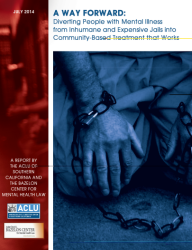
The ACLU SoCal and the Judge David L. Bazelon Center for Mental Health Law published A Way Forward, a report that sets forth recommendations that would allow Los Angeles County officials to establish and implement diversion programs for inmates with mental illness charged with non-violent offenses. Such programs save money, improve public safety by dramatically reducing recidivism and reduce jail overcrowding.
L.A. County's jail system is the nation’s largest psychiatric institution. On any given day, an estimated 3,200 inmates diagnosed with a severe mental illness crowd the jails. The number of suicides has increased over a two-year span, and inmates with mental illness are more likely to suffer abuse at the hands of other inmates or jail staff. The recidivism rates among inmates with mental illness are extraordinarily high.
In June 2014, the U.S. Department of Justice (DOJ) found that L.A. County violates the constitutional rights of inmates by failing to provide adequate mental health care and appropriate suicide prevention policies. DOJ encouraged the county's efforts to expand diversion programs for those inmates with mental illness. Diversion programs direct people with mental illness who have been arrested or are incarcerated for non-violent offenses to effective community-based programs that combine treatment with supportive housing, as well as medication management and employment assistance.
Learn more

%3Ciframe%20allow%3D%22autoplay%3B%20encrypted-media%22%20allowfullscreen%3D%22%22%20frameborder%3D%220%22%20height%3D%22315%22%20src%3D%22https%3A%2F%2Fwww.youtube.com%2Fembed%2Fwctorjq9phQ%3Fautoplay%3D1%26version%3D3%26playsinline%3D1%22%20width%3D%22560%22%3E%3C%2Fiframe%3E
VIDEO: A mother recounts her family’s tragic experience with the L.A. County Jails.Read media coverage of mental health in the jails:
- "A mental health jail is an oxymoron; diversion is what’s needed: Guest commentary," Patrisse Cullors-Brignac and Diana Zuniga. Pasadena Star, 24 June 2014.
- "Jackie Lacey says L.A. County should stop locking up so many people," Steve Lopez. LA Times, 10 May 2014.
- "Patience with the new jail," La Opinión, 8 May 2014. en Español
- "L.A. County needs to construct mental health programs, not just jails," Terry Smerling. LA Times, 4 May 2014.
- "L.A.'s jails: Where not to treat the mentally ill," Times Editorial Board. LA Times, 4 May 2014.
- "L.A. jail proposal would do little to help: Guest commentary," Hector Villagra. L.A. Daily News, 1 May 2014.
- "Inside a Mental Hospital Called Jail," Nicholas Kristof. NY Times, 8 February 2014.
- "Amid scrutiny, a surge of suicides in L.A. County jails," Steve Lopez. LA Times, 14 December 2013.
- "Court needs alternatives in handling mentally ill," Steve Lopez. LA Times, 5 October 2013.
- "Where mentally ill inmates actually get some help," Steve Lopez. LA Times, 10 August 2013.
- "Early intervention would keep more out of L.A. County Jail's snake pit," Steve Lopez. LA Times, 20 July 2013.
- "It's a crime to house the mentally ill this way," Steve Lopez. LA Times, 17 July 2013.
Date
Tuesday, July 1, 2014 - 4:00pm
Featured image
Show featured image
Hide banner image
Documents
Show related content
Pinned related content
Report offers roadmap for developing diversion programs for people with mental illness in L.A. County Jails
Tweet Text
[node:title]
Type
Menu parent dynamic listing
Style
Standard with sidebar
How Some California Charter Schools Illegally Restrict Enrollment
All across California, charter schools are implementing admissions policies that exclude students from enrolling. Like other public schools, charters must admit all students who wish to attend. By law, they may not discourage certain students from enrolling based on income, national origin, academic performance or other factors. These admission policies threaten to turn public schooling into a two-tier system where the students who need the most resources receive the fewest.
To realize charter schools' promise of providing educational choice to all, the ACLU SoCal and Public Advocates released Unequal Access: How Some California Charter Schools Illegal Restrict Enrollment, a July 2016 report that sheds light on exclusionary enrollment policies at 253 charter schools.
See a map of charter schools cited.
These charter schools post enrollment policies or forms online that are clearly illegal or exclusionary. Other schools may also maintain similar prohibited policies that are hidden from the public view. The violations we found include:
- Exclusion Based on Academic Performance
- Discrimination against English Learners
- Pre-Enrollment Essays or Interviews
- Requirements that Discourage Undocumented Students
- Illegal Parent/Guardian Volunteer Requirements
See the methodology for the report.
Read our followup brief after 119 schools on the list complied and changed their policies.
Date
Sunday, July 31, 2016 - 10:30am
Featured image
Show featured image
Hide banner image
Related issues
Education Equity
Documents
Show related content
Tweet Text
[node:title]
Type
Menu parent dynamic listing
Show PDF in viewer on page
Style
Standard with sidebar
In Rodriguez v. Robbins, the ACLU SoCal and the ACLU Immigrants' Rights Project represent a class of noncitizens who have been incarcerated for six months or longer in the Los Angeles area while they litigate their immigration cases, and who have been denied a constitutionally-adequate bond hearing to determine whether their prolonged detention is justified. In the past three years, the ACLU has won important rulings that have required the government to provide bond hearings to class members — their first meaningful opportunity to seek release and return to their loved ones during the lengthy time it can take for their cases to wind their way through the immigration court process.
The government has conducted thousands of bond hearings for class members under the court's orders over the past three years. Based on data produced by the government, this report presents statistics on the outcomes of class members' bond hearings during an 18-month period, from October 2012 to April 2014. It provides the first comprehensive examination of Rodriguez bond hearings, and provides important insight into the implementation of the court's orders and the immigration detention system more generally.
As documented in the report, immigration judges have found that the overwhelming majority of class members should be released on bond or other conditions of release. Thus, their prolonged detention — at great personal cost to themselves and their families and massive financial cost to taxpayers — was unnecessary.
Read the report
Date
Friday, December 5, 2014 - 6:45pm
Featured image
Show featured image
Hide banner image
Related issues
Immigrants' Rights
Documents
Show related content
Tweet Text
[node:title]
Type
Menu parent dynamic listing
Show PDF in viewer on page
Style
Standard with sidebar
Pages