Food Oppression in the Orange County Jails
For almost two years, people incarcerated in Orange County jails have been issued bagged, cold meals every day consisting of slimy bologna, no matter if it’s for breakfast, lunch, or dinner. And all too often, it is served on bread that is rotting, moldy and even, at times, infested with bugs.
Not only are these meals hugely unappetizing, they are also unhealthy because of their extremely high levels of sodium and cholesterol.
A new report, “Cold, Rotting, & Moldy Meals: Food Oppression in the Orange County Jails,” was produced by the Stop the Musick Coalition that investigated the inhumane food situation in the jails overseen by the Orange County Sheriff’s Department (OCSD).
Download the report (.pdf)
Coalition members used a Public Records Act request to obtain official documents from the OCSD and they conducted interviews with people who had been incarcerated in the jail system.
The report finds that:
- The jail kitchens were closed in March 2020, and hot meals still have not been fully reinstated.
- The jails have been serving cold and frequently moldy or rotting bologna sandwiches for every meal.
- The meals offer poor nutrition and contain excessive levels of sodium.
- During this time, OCSD has saved significant funds (almost $1 million in 2020) allocated to the food service budget.
- During this time, despite an almost-50 percent drop in the jail population, the commissary store has continued to bring in consistently high revenue by selling snack food items that many incarcerated people, if they can afford it, purchase to supplement the bagged meals.
The Stop the Musick Coalition consists of individuals and organizations committed to decarceration in Orange County. The coalition opposes the reopening and expansion of the now empty James A. Musick Facility that would add more than 3,000 jail beds to OC’s current jail capacity and cost more than $280 million in state and county funds.
Members of the coalition that contributed to this jails food report include the ACLU SoCal, CLUE: Clergy and Laity United for Economic Justice, Housing is a Human Right OC, Orange County Rapid Response Network, Transforming Justice OC, and Underground Grit.
Date
Tuesday, December 14, 2021 - 4:00pm
Show featured image
Hide banner image
Related issues
Jails Project
Criminal Justice and Drug Policy Reform
Documents
Show related content
Tweet Text
[node:title]
Type
Menu parent dynamic listing
Show PDF in viewer on page
Style
Standard with sidebar
Show list numbers
The Legal War Against Unhoused People
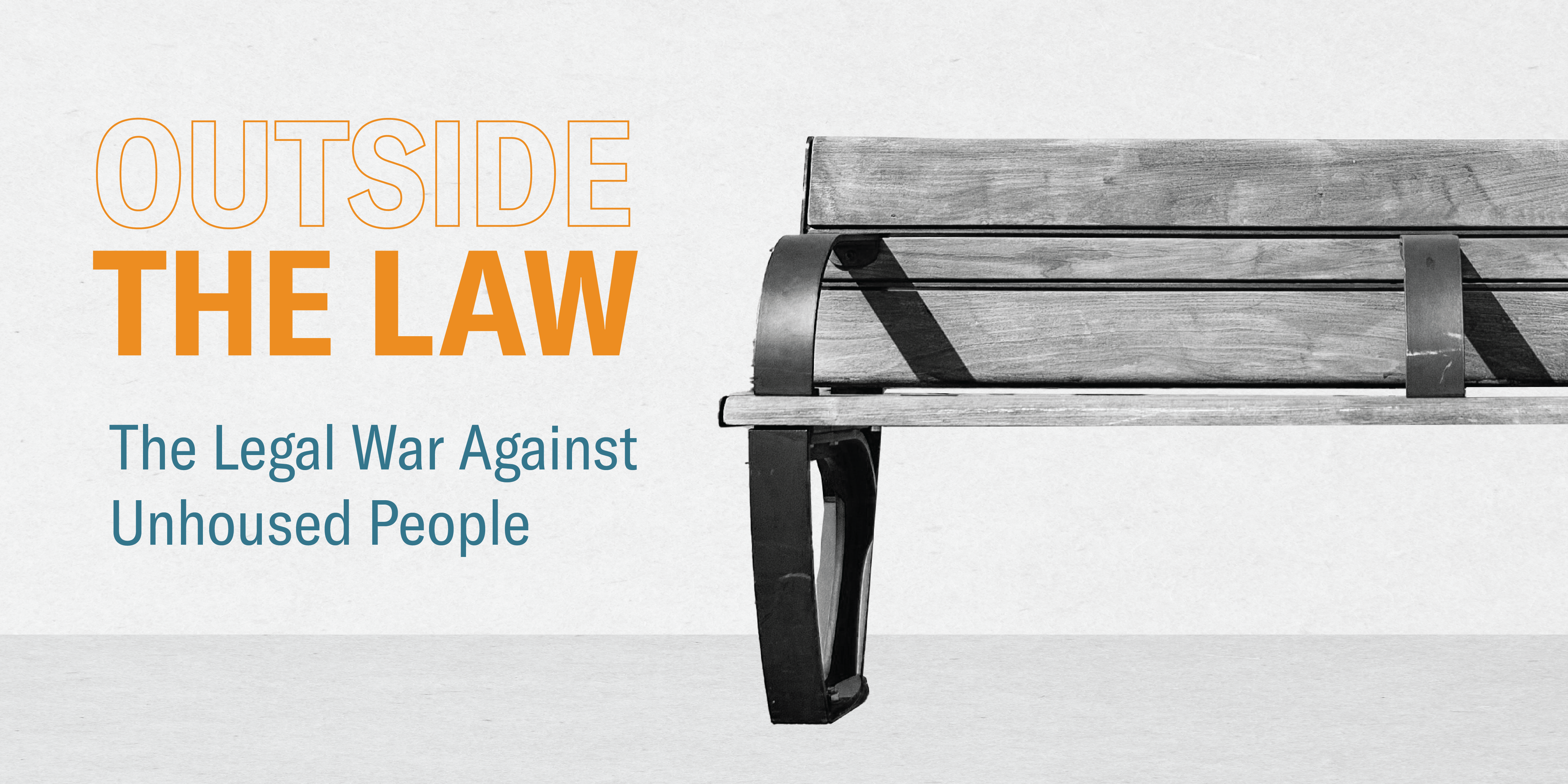
The plight of people who are unhoused has reached horrific proportions in California, but instead of embarking on a resurgence of affordable housing, communities have instead instituted policies and regulations that target unhoused people by harassing, citing, segregating, banishing, and even imprisoning them.
A new, comprehensive report, “Outside the Law: The Legal War Against Unhoused People,” by the ACLU Foundations of Northern California, Southern California, and San Diego & Imperial Counties spotlights the discriminatory tactics that cities and counties throughout California have instituted to target unhoused people, ignoring the bedrock principle of equal treatment under the law. It calls upon communities to amend anti-discrimination laws to include unhoused people and acknowledge their fundamental human rights.
Read the full report
The report finds that:
- Discrimination against unhoused people is spreading and becoming more commonplace, especially due to local governments exploiting legal loopholes and sharing their tactics with one another.
- Municipalities are increasingly imposing fines and fees — even for sitting in a public park for only a few minutes — far beyond an unhoused person’s ability to pay.
- Cities are targeting not just unhoused people, but also the humanitarian organizations that provide critical aid such as food, water, clothing, and blankets.
- Unhoused people are being forcibly banished to remote areas, including harsh desert landscapes, outside city borders, and far from lifesaving resources such as water, food, and health care.
The ordinances and regulations adopted by cities are often purposely vague as to allow for harassment. An example cited in the report is from the city of Novato where camping was banned in city parks, open spaces, within 50 feet of “critical infrastructure,” etc. When asked where unhoused people could exist, the city manager answered, “Anywhere it’s not illegal would be legal.”
Other California cities whose policies and practices against unhoused people are cited in the report include: Chico, Laguna Beach, Lancaster, Los Angeles, San Diego, Santa Ana, and Santa Cruz.
Read the full report
Date
Tuesday, October 26, 2021 - 6:15am
Featured image
Show featured image
Hide banner image
Related issues
Economic Justice
Documents
Show related content
Tweet Text
[node:title]
Share Image
Type
Menu parent dynamic listing
Show PDF in viewer on page
Style
Standard with sidebar
Show list numbers
A Vision for Safe and Supportive Schools in California
Over the past few decades, police have become a dominant fixture in California schools. Their presence has devastating and discriminatory impacts on tens of thousands of California students.
Policing in the U.S. has historical roots in slave patrols, which violently abducted Black people who escaped enslavement, and in the forced dislocation of indigenous youth to “boarding schools” designed to erase their cultural ties. As communities across the country came together to reevaluate the role of police in enacting racism in the wake of George Floyd’s murder by police officers, youth activists effectively continued to advocate to remove police from schools. Since then, school districts in Oakland, Los Angeles, Pomona, and Claremont, among others, have fully eliminated or made progress towards eliminating school police.
“No Police in Schools: A Vision for Safe and Supportive Schools in CA” analyzes data from the U.S. Department of Education’s 2017-18 Civil Rights Data Collection (CRDC), the 2019 California Racial and Identity Profiling Act (RIPA) Stops dataset, and data from Stockton Unified School District on police in schools. The data conclusively show harmful and discriminatory policing patterns in schools. School police contribute to the criminalization of tens of thousands of California students, resulting in them being pushed out of school and into the school-to-prison pipeline. Critically, the data suggest that schools underreport the number of assigned law enforcement officers, so these problems are likely even more severe.
Download the report (.pdf)
KEY FINDINGS
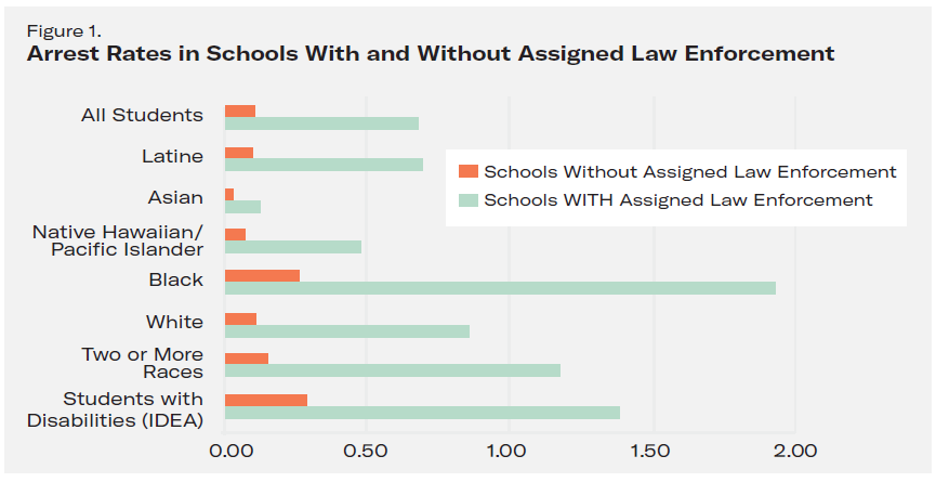
Students were far more vulnerable to arrest and referrals to police in schools with assigned law enforcement than in schools without.
- Black students’ arrest rates are 7.4 times higher in schools with assigned law enforcement than in schools without, and their law enforcement referral rates are 4.7 times higher.
- Latine students’ arrest rates are 6.9 times higher in schools with assigned law enforcement than in schools without, and their law enforcement referral rates are 4.4 times higher.
- Students with disabilities’ arrest rates are 4.6 times higher in schools with assigned law enforcement than in schools without, and their law enforcement referral rates are 4.8 times higher.
Law enforcement proponents attempt to explain the correlation between police in schools and heightened rates of arrests and referrals by speciously arguing that schools with assigned permanent law enforcement officers are inherently more dangerous. Baldwin Park Unified School District serves as an instructive counterexample to this assertion. From 2010 to 2017, the district had no police on staff. It then hired six officers in September 2017 and increased the police force to nine officers in 2019. Law enforcement referrals more than doubled to 347 in the 2017-18 CRDC after the district hired the police officers. Critically, during that time, arrests actually fell from 70 to 52, suggesting that the officers were called for issues that did not warrant arrests and should have been handled by school staff.
School police disproportionately arrest and cite Black students, Latine boys, and students with disabilities.
- Black students are three times more likely to be referred to law enforcement compared to white students.
- Black girls are six percent of California’s female student population but 18 percent of female student arrests.
- Latine boys are 28 percent of California’s students but 44 percent of student arrests.
- Students with disabilities are 11 percent of California’s students but 26 percent of student arrets.
- Black and Latine boys with disabilities are five percent of California’s students but 13 percent of referrals to law enforcement and 15 percent of school arrests.
The 2019 RIPA data confirm that police disproportionately stop Black students and subject them to harsher consequences.
- Black students are only 7.6 percent of students in schools in the dataset but represent 26 percent of law enforcement stops of students aged 5 to 19 by California’s 15 largest police agencies.
- Police handcuffed 15.7 percent of all students stopped in response to calls for service and 27.1 percent of all Black students stopped in response to calls for service.
- Police arrested only 12 percent of white students but 20 percent of Black students during stops.
A detailed analysis of policing in Stockton Unified School District also confirms the trends seen in the statewide data.
- From 2017 to 2020, Native American students were booked or cited by Stockton USD police at five times their rate of enrollment in school, and Black students were booked or cited at nearly three times their rate of enrollment.
- In 2019, Black students were six-and-a-half times more likely than white students to be booked or cited by Stockton USD police, and Native American students were over three times more likely than white students to be booked or cited by Stockton USD police.
“I want the removal of police from schools, starting IMMEDIATELY with elementary and middle schools. There is no situation that should require constant or even regular police presence with children so young. Please do not make the mistake of being yet another system that has taught children of color that they do not matter.” – Current Los Angeles USD Student
RECOMMENDATION
No school in California should have a permanent police officer. School districts should not be able to create their own police departments or reserve forces, nor should they coordinate with any outside law enforcement agency to station law enforcement on a school campus.
To achieve justice for our youth and to provide them with the education they deserve, we must reevaluate the entire system: reimagining safety without police and school hardening measures, reinvesting in the positive supports that actually help our students, and fundamentally changing the culture of our schools.
RESOURCES
Date
Tuesday, August 24, 2021 - 8:30am
Featured image
Show featured image
Hide banner image
Related issues
Education Equity
Documents
Show related content
Tweet Text
[node:title]
Share Image
Type
Menu parent dynamic listing
Show PDF in viewer on page
Style
Standard with sidebar
Show list numbers
Pages