
News & Commentary
May 16, 2013
ACLU/SC's Statement on the End of the LAPD's Consent Decree
By Hector Villagra, Executive Director, ACLU of Southern California
The consent decree secured by the ACLU Foundation of Southern California and the Justice Department accomplished its purpose by and large. This is no longer your father’s Los Angeles Police Department.
By Marcus Benigno

May 15, 2013
ACLU/SC: It All Began With an Arrest in 1923
On May 15, 1923, angered by the LAPD's brutal treatment of striking longshoremen, journalist and novelist Upton Sinclair appeared at a rally in San Pedro. Because the police banned all public meetings by the unionized strikers, the rally was held, with the owner's written permission, on private property prophetically named "Liberty Hill." Sinclair began reading the First Amendment.
By Hector Villagra, Stephen Rohde

May 06, 2013
Automated License Plate Readers Threaten Our Privacy
Law enforcement agencies are increasingly using sophisticated cameras, called “automated license plate readers” or ALPR, to scan and record the license plates of millions of cars across the country.
By Peter Bibring


Apr 29, 2013
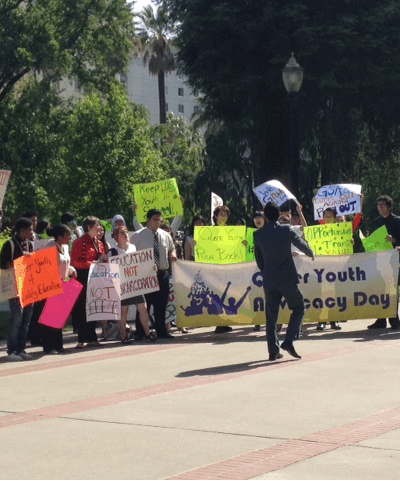
Advocating for LGBTQ Youth
by Joey Hernandez, LGBTQ Student Rights Advocate
Over the years, the north steps of the State Capitol have seen some fierce advocacy by queer youth from across the state of California. The ACLU of California is keeping that legacy alive in the 2013 legislative cycle.
By Glen Eichenblatt
Apr 29, 2013
Our True Americanness
by Hector Villagra, Executive Director of the ACLU of Southern California
Historian Eric Foner has said that "[l]ike all great historical transformations, emancipation was a process, not a single event. It arose from many causes and was the work of many individuals."
We are now living through and are on the verge of a great historical transformation, as evidenced by the release of the so-called gang of eight's long-awaited immigration proposal. This transformation, some 20 years in the making, has definitely been a process.
By Glen Eichenblatt

Apr 24, 2013
Historic Decision Recognizing Right to Counsel for Group of Immigration Detainees
By Esha Bhandari, Equal Justice Works Fellow, ACLU & Carmen Iguina, Equal Justice Works Fellow, ACLU of Southern California
In a landmark ruling yesterday, Federal District Judge Dolly M. Gee ordered the federal government to provide legal representation for immigrant detainees in California, Arizona and Washington who have serious mental disabilities and are unable to represent themselves in immigration court.
By Glen Eichenblatt
Apr 16, 2013
On Eve of Immigration Reform Rollout, Immigration Detainees Win Right to Fair Hearing
By Michael Tan, Staff Attorney, Immigrants' Rights Project, ACLU National
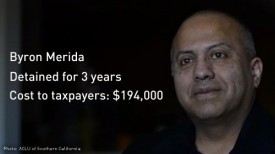
Today the U.S. Court of Appeals for the Ninth Circuit issued a landmark ruling that curtails one of the most wasteful and draconian features of our immigration lock-up system: the government's practice of putting immigration detainees behind bars for months or even years, without ever holding a bond hearing to determine if they should be locked up in the first place. In Rodriguez v. Robbins, a class-action lawsuit brought by the ACLU, the Court upheld an order requiring bond hearings for detainees locked up six months or longer while they fight their deportation cases. The ruling stands to benefit thousands of immigration detainees across the Ninth Circuit, where an estimated 25% of immigrant detainees are held every year.
By Glen Eichenblatt
Stay Informed
Sign up to be the first to hear about how to take action.
By completing this form, I agree to receive occasional emails per the terms of the ACLU’s privacy statement.
By completing this form, I agree to receive occasional emails per the terms of the ACLU’s privacy statement.