The Need for a Towing Moratorium in CA During COVID-19
March 17, 2020
Governor Gavin Newsom
1303 10th Street, Suite 1173
Sacramento, CA 95814
Dear Governor Newsom:
To help prevent the spread of the Novel Coronavirus and the rate of infection of COVID19 in California, we request that you issue an executive order placing a moratorium on all vehicle tows, other than those necessary for public safety or criminal enforcement. For many unhoused Californians, vehicles are the only shelter option for quarantine, and for many health care workers in the state, a car is the only transport they have to get to work. The City of San Francisco just yesterday announced its own towing moratorium, and this is urgently needed throughout the rest of California.
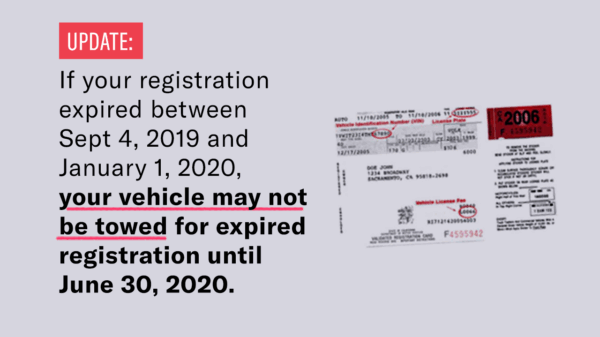
We are a coalition of groups who have studied towing in California extensively — see Towed into Debt: How Towing in California Punishes Poor People — who serve and represent hundreds of thousands of Californians, and who work on economic justice issues across the state. Analysts estimate that public agencies towed nearly one million cars in 20161. The most minor reasons for tow are some of the most common: over one fourth of all tows in 2016 were for unpaid parking tickets, unpaid registration, or a car being legally parked in one place for more than 72 hours. Because the average cost to retrieve a vehicle after it has been towed is $1,100, many Californians lose their vehicle completely after a tow because they cannot afford to pay; more Californians will be unable to pay as their hours and jobs are cut during the pandemic.
The loss of a family’s key economic asset, transport to work or medical care, or shelter, is devastating in the best of times. In a time of required social distancing and self-quarantine, it presents a significant public health problem. Specifically:
- Over 75% of Californians drive to work. Without vehicles, many health care workers will not be able to get to their shifts, or will be more exposed to catching or spreading COVID-19 on public transportation.
- Vehicles are a primary form of transport to health care for many Californians. If public agencies continue to tow hundreds of thousands of cars, people with severe COVID-19 symptoms who need to get to the hospital will similarly not have a safe means of transport. Family members who need their car to care for a sick relative will also be left vulnerable, as will their relative. They will also lose access to transport needed for essential household activities such as obtaining groceries and regular medicine.
- Many of the current tow laws require people to go into public sphere.
Towing laws require towing companies to send their workers into the community to physically remove people’s cars from the streets. o To comply with the 72-hour rule, people must leave their homes to move their cars. In a time of self-quarantine, this is simply an unnecessary and potentially dangerous act. o To retrieve a towed car, the owner must go in person to a tow yard (either on public transportation or having another person drive them in their car), then interact in person with representatives of the tow yard to process payment for the tow and retrieve physical custody, and drive home.
State law governs the circumstances when local governments can tow vehicles. The United States and state of California state of emergencies gives you the authority to limit tows. We request that you issue an order, as San Francisco did, suspending all tows that are unnecessary for public safety. Attached hereto is a draft order that would:
- Suspend the authority of local agencies to tow cars for reasons other than public safety or criminal enforcement.
- Specify that when agencies tow vehicles to clear roadways, driveways, or disabled parking spots, they will move the vehicles to the nearest legal parking place – not a tow lot – and give owners notice about where the find the car.
- Require agencies to release, without charging a fee, any vehicle currently impounded for non-public safety reasons upon a showing that the owner is homeless, indigent, or a health care worker.
- The draft order leaves in place all laws related to towing vehicles as part of a criminal enforcement action.
We request this moratorium remain in place at least until May 31, 2020, and for so long the duration of either the National or State emergency, whichever is longer.
We appreciate your leadership in this difficult time. We thank you for your consideration of this public health measure.
Sincerely,
| ABD Productions American Civil Liberties Union of California Bay Area Legal Aid Berkeley Free Clinic Coalition on Homelessness Code Tenderloin Community Forward S.F. Community Housing Partnership Compass Family Services Do No Harm Coalition at UCSF Dolores Street Community Services Drug Overdose Prevention & Education Project East Bay Community Law Center Elder Law and Disability Rights Center Ella Baker Center for Human Rights Eviction Defense Collaborative GLIDE Memorial Hamilton Families Hospitality House Housing Rights Committee of San Francisco LavaMaeX |
Lawyers’ Committee for Civil Rights of the San Francisco Bay Area Legal Aid Foundation of Los Angeles Legal Services of Northern California Mission Neighborhood Resources Center POOR Magazine – Prensa Pobre – Homefulness Public Counsel Safe Parking L.A. San Francisco AIDS Foundation San Francisco Safe House San Francisco Supportive Housing Provider Network Senior and Disability Action St. Anthony’s Street Sheet Swords to Plowshares Tenderloin Neighborhood Development Corporation Tenderloin Walking Tours The Gubbio Project United Council of Human Services Venice Community Housing Western Center on Law and Poverty Western Regional Advocacy Project |
cc: David Chiu, Assembly Member, Seventeenth District
1. See Lawyers’ Committee for Civil Rights of the San Francisco Bay Area et al., Paying More for Being Poor: Bias and Disparity in California’s Traffic Court System, 8 (2017), available at https://www.lccr.com/wpcontent/uploads/LCCR-Report-Paying-More-for-Being-Poor-May-2017.pdf.