Lactation Rights at Work
Last updated: January 22, 2019 01:30 pm
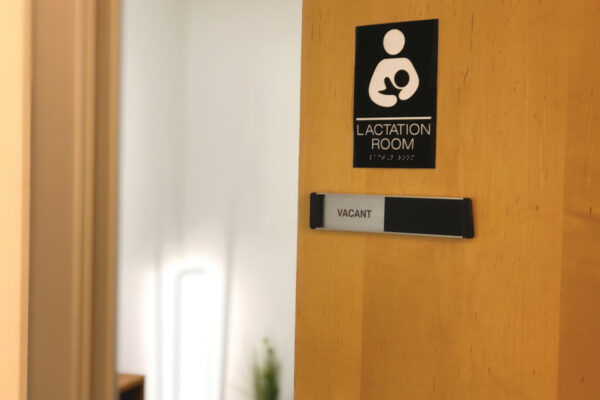
You have the right to express breastmilk at work. You have the right to pump breastmilk at work. Most employers in California are required to provide you with a private room and a reasonable amount of break time to pump at work.
If I want to pump at work, what type of lactation accommodations is my employer required to provide?
Your employer is required to provide you with a lactation room that is private, secure, clean, free of hazardous materials, shielded from view, and free from intrusion by supervisors, coworkers, and the public. As of January 1, 2020, the room must contain a place to sit, a table or shelf to place a breast pump and other equipment, and access to a power source to plug in an electric pump.
Can my employer set up a lactation area in the bathroom?
No. The lactation room must be a separate, private room that is not a bathroom.
Can my employer designate a multi-purpose room — like a conference room — as a temporary lactation room?
Yes, but the law requires that use of the room for lactation takes precedence over other uses.
I work in a building that houses many employers. Is my employer still required to provide a lactation room?
Yes. A multi-tenant building or multi-employer worksite must still provide lactation accommodations, but the lactation room may be shared among multiple employers.
I’m a subcontractor. Does the employer or general contractor still need to provide me with a lactation room?
Yes. You should submit a written request to the employer or general contractor stating that you are lactating and asking for lactation accommodations. Upon receipt of your request, the employer or general contractor is required to provide you with lactation accommodations within two business days.
I need to store my milk. Is my employer required to provide me with a refrigerator?
As of January 1, 2020, your employer is required to provide you with a cooling device to store your milk, such as a refrigerator or an employer-provided cooler.
I need to wash my hands and my pumping equipment. Is my employer required to provide me with a sink?
As of January 1, 2020, your employer must provide you with a sink that’s in close proximity to your workstation.
How many lactation breaks am I allowed to take?
Your employer is required to give you a reasonable amount of break time to pump. The law doesn’t specify an amount of time, but federal regulations advise employers to provide 2-3 breaks during an 8-hour shift and sufficient time for the lactating parent to walk to the designated space, wait for use of the space, set up the pumping equipment, retrieve the milk, clean the equipment afterwards, and store the milk.
Are my lactation breaks paid?
Not necessarily. While your employer must allow you break time to pump, they are not required to compensate you for that time. However, if your employer already offers paid breaks and you use those paid breaks to pump, your time should be paid as usual. For example, if you usually receive a 15-minute paid break, and you take 20 minutes to pump, your employer must pay you for the first 15 minutes but is not required to pay you for the last 5 minutes.
How long can I pump at work?
The law allows you to take lactation breaks to express milk for an “infant child,” but doesn’t define infancy for these purposes. Courts are likely to find the right to take lactation breaks for 1-3 years.
Can my employer require me to submit a doctor's note to prove I need to pump at work?
No. Your request for lactation accommodations triggers your employer’s obligation to provide you with a private lactation room and break time. You don’t need to submit any proof that you’re lactating.
What if I work in an agricultural setting?
You still have lactation rights, even if you work in an agricultural setting without traditional office space. In this circumstance, your employer must provide you with a private, enclosed, and shaded space, such as an air-conditioned cab of a truck or tractor.
Can I bring my baby to work with me so I can breastfeed?
It depends. In California, you have the right to breastfeed your child in any location – other than someone else’s private home– in which you and your child are authorized to be. But, employers do not have a legal obligation to permit parents to bring their children to work. If your employer does not allow children in the workplace, then you do not have a right to breastfeed at work.
Are there exceptions to these requirements?
Yes. If an employer has less than 50 employees and can demonstrate to the California Department of Industrial Relations that these requirements would impose an undue hardship or cause a serious disruption, then the employer will be granted an exemption to the rule. Even with the exemption, the employer must still make reasonable efforts to provide a room or location for pumping milk that is not a toilet stall.
Can my employer harass, discriminate, or retaliate against me for taking lactation breaks?
Absolutely not. You have the right to take lactation breaks, and it is against the law for your employer to harass, discriminate, or retaliate against you for requesting or taking breaks.
What can I do if I believe my rights have been violated?
If your employer refuses to provide you with a room to pump or with lactation breaks, you can file a complaint with the California Division of Labor Standards Enforcement (DLSE), the California Department of Fair Employment and Housing (DFEH), and the U.S. Department of Labor (DOL).
If your employer harasses, discriminates, or retaliates against you, you can file a complaint with the DFEH or the U.S. Equal Employment Opportunity Commission (EEOC).
You can also contact us if you have any more questions or believe your rights have been violated.
Related Content

New Mother Sexually Harassed at Mojave Desert Military Base
Stay Informed
Sign up to be the first to hear about how to take action.
By completing this form, I agree to receive occasional emails per the terms of the ACLU’s privacy statement.
By completing this form, I agree to receive occasional emails per the terms of the ACLU’s privacy statement.