
Protesters
Last updated: October 29, 2025 06:22 pm
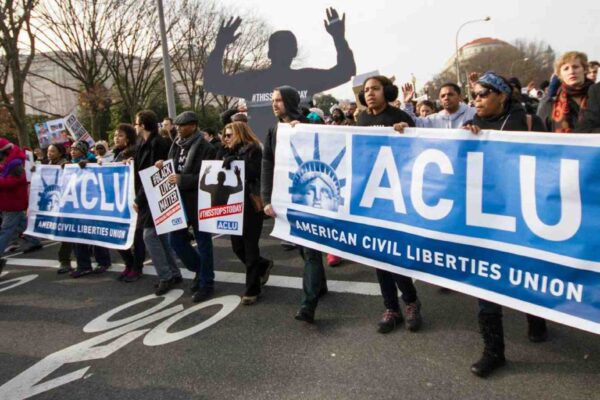
If you take part in a protest
You may:
- Distribute leaflets, flyers or other literature on your own property or on public sidewalks, parks and plazas
- Picket or protest on public sidewalks, parks and plazas so long as sidewalks and building entrances are no blocked
- Chant or sing protest songs on public sidewalks, parks and plazas
You may not:
- Block access to sidewalks or buildings
- Disrupt counter-protests
- Engage in speech that is obscene, makes knowingly false statements of fact, or that is likely to incite an immediate disruptive or dangerous disturbance
Additionally, you may not be able to march in the streets without a permit in some jurisdictions, and you may be required to follow local traffic rules. See below for more details.
Other important things to know:
- If you are stopped by law enforcement, the military or federal agents, ask if you are free to go. If they say yes, calmly walk away.
- If you are arrested or detained, you have a right to ask why. Otherwise, say you wish to remain silent or let them know you’ll only answer questions in the presence of an attorney – no matter your citizenship or immigration status.
Additionally, you may not be able to march in the streets without a permit in some jurisdictions, and you may be required to follow local traffic rules. See below for more details.
Here’s what you should know if you believe your rights to free speech are violated:
- When you can, write down everything you remember, including what the officers' uniform looked like, badge and patrol car numbers, and the agency they work for.
- Get contact information for witnesses.
- Take photographs of any injuries.
- Once you have all of this information, you can file a written complaint with the agency's internal affairs division or civilian complaint board, or submit an online intake form to tell ACLU SoCal about violations of the court order restraining federal agents.
FAQs
How does the L.A. Press Club v Noem case affect our protest rights today?
This summer, in retaliation for documenting and protesting ICE activity, federal agents brutalized protesters, journalists and legal observers across Southern California. Thankfully, last month, a district court judge granted our request to block DHS from continuing their use of excessive force against the public and press. The court’s order bars federal agents from using chemical weapons (like tear gas and pepper spray), projectile weapons (like pepper balls and rubber bullets), and flash-bang grenades against protesters who are not threatening officers. Read the court order for more information.
Where may I engage in free speech activity?
Generally, all types of expression are constitutionally protected in traditional "public forms" such as streets, sidewalks, parks and public plazas. California permits speech activities, such as handing out leaflets, in facilities operated by state and local governments and open to the public as long as they do not significantly disrupt the normal operations of the facility. These speech protections do not apply to federal government facilities, such as the interiors of federal office buildings or courthouses, where significant restrictions on activities such as chanting, handing out leaflets, etc. may apply. In addition, free-speech activity generally cannot take place on private property absent the consent of the property owner, except where the property is open to the public in the same way as a public street or park, like a shopping mall, but not a strip mall, or in front of big box stores. Shopping malls must allow speech activity subject to reasonable time, place and manner rules— ask your local mall for their rules.
Do I need a permit before I engage in free speech activity?
Not usually; however, the government may require permits for certain types of events. Generally, these events are: 1) a march or a parade that does not stay on the sidewalk, and other events that require street closures; 2) a very large rally; and 3) activity which obstructs vehicle or pedestrian traffic. Many permit procedures require that applications be filed with the police department or the city or county well in advance of the event. However, the government must allow you to obtain a permit on short notice if the event is organized in response to unforeseeable and recent occurrences.
If organizers have not obtained a permit, where may a march take place?
In general, if groups of individuals stay on the sidewalk and obey traffic and pedestrian signals, their activity is protected. They may be required to allow enough space on the sidewalk for normal pedestrian traffic and may not obstruct or detain passers-by. It is always advisable to check with the city or the police to find out about permitting requirements—contact your local ACLU affiliate if the requirements seem unreasonable.
May I distribute leaflets and other literature on public sidewalks?
Yes. Pedestrians on sidewalks may be approached with leaflets, newspapers, petitions and solicitations for donations. Tables may also be set up on sidewalks for these purposes as long as demonstrators do not block entrances to buildings and passers-by are not physically detained. No permits are required.
Do I have a right to picket on public sidewalks?
Yes. No permit is required to picket, but it must be done in an orderly, non-disruptive fashion so that pedestrians can pass and entrances to buildings are not blocked. Pickets are not required to keep moving but may remain in one place as long as they leave room on the sidewalk for others to pass. Some jurisdictions may have restrictions prohibiting “targeted residential picketing” within a set number of feet of a residential dwelling or real estate parcel.
Do counter-demonstrators have free speech rights?
Counter-demonstrators should not be allowed to physically disrupt the event they are protesting, but they do have the right to be present and to voice their disagreement with the demonstrators' message. Police are permitted to keep two antagonistic groups separated but should allow them to be within the general vicinity of one another.
Are you allowed to disrupt another person’s speech?
In the context of a public meeting, although the law is not settled, heckling should be protected unless you are attempting to physically disrupt an event, are drowning out the other speakers or otherwise substantially disrupting the event in a way that is not customary for the event.
Is it legal to silence a speaker for provoking a crowd?
Generally, no. Even the most inflammatory speaker cannot be punished for merely arousing the audience. A speaker can be arrested and convicted for incitement only if s/he specifically advocates illegal actions and only if those illegalities are imminently likely to occur.
May the government impose a financial charge for exercising free speech rights?
Some courts have permitted charges that cover actual administrative costs or the actual costs of re-routing traffic. However, if controversy or the content or viewpoint of the speech is used to apply higher costs— such as requiring a large insurance policy — or if the charges are entirely arbitrary, then the courts will not permit it. Regulations with financial requirements should include a waiver for groups that cannot afford the charge. Check to see if other groups have been granted waivers in the past—if so, denying your group a waiver may be discriminatory.
View the National Lawyers Guild’s Legal Observer Training Manual for more information on assisting with training legal observers.


Stay Informed
Sign up to be the first to hear about how to take action.
By completing this form, I agree to receive occasional emails per the terms of the ACLU’s privacy statement.
By completing this form, I agree to receive occasional emails per the terms of the ACLU’s privacy statement.