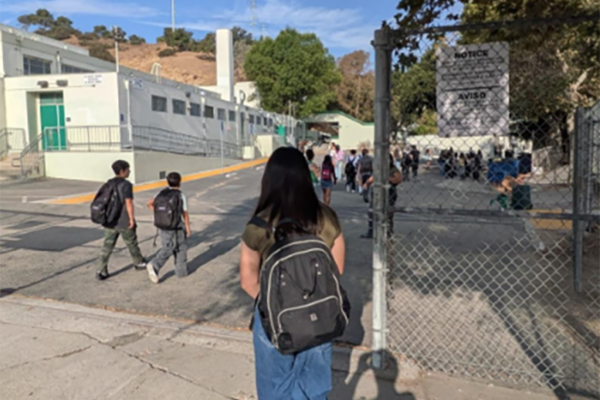
As I sent my sixth and ninth graders off for their first day of school in Los Angeles Unified School District, I had mixed feelings.
On one hand, I was looking forward to the learning, growth and new friendships ahead of them. My sixth grader put on her uniform and headed off for her first day of middle school eager to take dance and animation, continue her Spanish and start a new chapter. Meanwhile, my ninth grader began high school looking forward to her first ethnic studies class and more student activism opportunities. Last year, she got involved in the LAUSD student walkouts, the first time she joined a protest on her own.
But alongside that parental optimism, I worry about whether school will be a safe and welcoming place for all young people.
California has passed important protections limiting immigration enforcement at schools, yet many immigrant families remain afraid. Many young people, including my own, fear the police and feel less safe when they see police cars in or around their schools. And despite California’s strong protections for LGBTQ youth, federal attacks and right-wing efforts to deny queer young people like my daughter the right to exist as their authentic selves are frightening.
Strong laws also do not necessarily determine what a child experiences in the hallway or classroom. My children have faced racist, anti-Asian comments from classmates. Their Black friends have been subjected to anti-Black slurs, and their Latine friends have been asked if they are going to be deported. My kids tell me that homophobic comments are commonplace, and they have watched teachers misgender their friends.
Immigrant students, LGBTQ students and students of color have rights. But if you ask my kids, they will tell you that rights are not enough—and that discipline is certainly not the answer.
My ninth grader thinks that education is part of the solution. She wants ethnic studies to begin before high school and wants young people to experience history not only through textbooks, but through storytelling, meeting and hearing from people with lived experiences and opportunities to experience history firsthand. Visiting civil rights sites like the Legacy Museum in Montgomery, Alabama transformed the way she understood our country’s history. She wants other young people to have experiences like that, too.
I would add that relationships matter. Of the incidents that my kids told me about, the only one that resolved positively was when they encouraged one of their friends to confront another friend who had used a racial slur. Because a relationship already existed—and because their teacher had fostered a positive classroom climate—the two were able to have a productive conversation. The child apologized and did not use the slur again.
That experience reminds me that accountability does not have to mean punishment. Relationships can transform what happens when an incident or disagreement occurs. But changing the conditions that shape an entire school or district or system requires relationships at scale. That’s collective action.
We can see the power of collective action all around us from the mutual aid and rapid response networks that have sprung up to protect immigrant families to the tangible wins by grassroots coalitions led by young people, families and community organizations like the Police Free LAUSD Coalition and Gente Organizada. Legal and policy protections are necessary, but they are not sufficient on their own. Community makes those protections real by knowing our rights, building relationships and acting together when those rights are threatened. Ultimately, we are the ones who keep us safe.
As I watch my children embark on the new school year, I still carry both hope and worry with me. But I also know that safer, more welcoming schools are something we can build together—by knowing our rights, strengthening our relationships, advocating for one another and giving young people the tools to create the schools they deserve.
The ACLU has several resources to support students and families to take collective action, including: “Know Your Rights” guides, a toolkit on sanctuary schools and a step-by-step advocacy toolkit on Free to Learn, Free to Be for students and parents.